Voting - The Senate
Half and full Senate elections
Senators are elected by a preferential voting system, known as proportional representation.
Candidates for the Senate stand for a State or Territory. It is a Constitutional requirement that each State be equally represented regardless of its population.
There are a total of 76 Senators: 12 for each State and two for each Territory. Senators for each State are elected for a six year term. Senators for each Territory are elected for a term equivalent to the duration of the House of Representatives. Forty Senate vacancies are contested at a half-Senate election.
When a Double Dissolution is declared as there was in 1987, all 76 Senate positions are made vacant.
Senate ballot papers
The order of the candidates on the ballot paper is determined by a random draw conducted in the office of the Australian Electoral Officer for that State or Territory, following the public declaration of nominations. Senate ballot papers are white in colour.
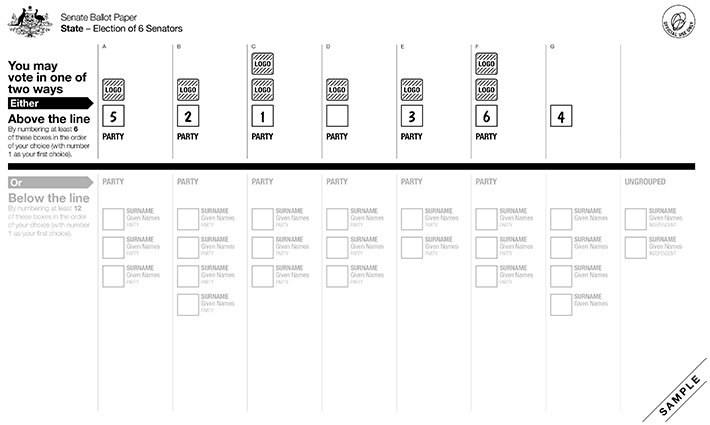
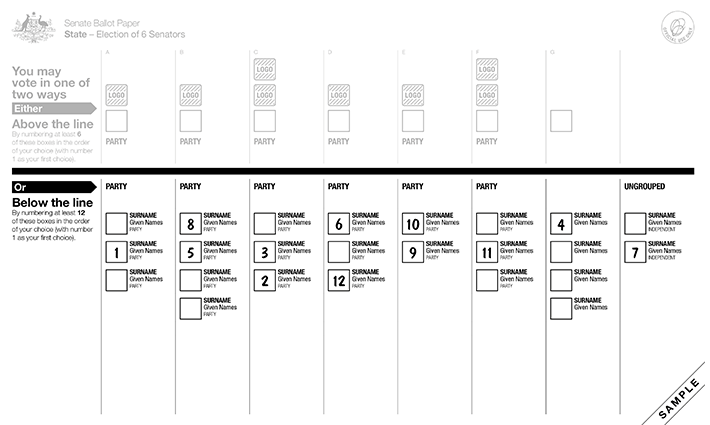
How to complete the ballot paperThe ballot paper is divided into two sections to distinguish the two alternative methods of voting for Senators:
1. Above the lineVoters may vote for a political party or group by putting the number ‘1’ in one box only above the black line. The rest of the ballot paper is left blank.
By casting a vote this way, voters are following the group voting ticket that the party or group has lodged with the AEC. All the preferences will be distributed according to the group voting ticket.
2. Below the lineIn the section below the line electors can vote by putting the number '1' in the box of the candidate they want as their first choice, number '2' in the box of the candidate they want as their second choice, and so on until all the boxes have been numbered. The top part of the ballot paper is left blank.
You must put a number in every box below the black line. You decide your own order of choice for all the candidates.
Group Voting Ticket
If you choose to vote ‘below the line’ you need to allocate all of your preferences, or votes, to all of the candidates in the section ‘below the line’ by numbering all the boxes.
However if you choose to vote ‘above the line’ it means that your preferences, or votes, will be allocated in accordance with the group voting ticket that the party or group you selected has lodged with the Australian Electoral Commission (AEC). This means instead of you numbering all the boxes ‘below the line’ the AEC will automatically allocate your preferences, or votes, in the predetermined order outlined in their group voting ticket.
A group voting ticket looks similar to a completed Senate ballot paper. A booklet with all the group voting tickets for your state can be viewed at your polling place or online, they clearly show the order in which the party or group will allocate your preferences, or votes. Each party or group can register up to three group voting tickets.

Informal votes
An informal ballot paper is one that has been incorrectly completed or not filled in at all. Informal votes are not counted towards any candidate but are set aside.
A Senate ballot paper is informal if:
- it is unmarked
- it has not received the official mark of the presiding officer and is not considered authentic
- it has writing on it which identifies the voter
- the voter's intention is not clear.
A vote above the line will be informal if:
- it has no first preference mark
- if there is more than one first preference mark.
A vote below the line is informal if:
- it has no first preference mark
- a tick or cross has been used as a first preference mark
- there is more than one first preference mark
- there are 10 or more candidates and there are not numbers in at least 90% of the squares next to the candidates names, which form a sequence of consecutive numbers beginning with the number 1, without repetition or omission, or numbers which would be such a sequence with changes to not more than three of them.*
- there are less than 10 candidates and there are not numbers in all of the squares next to the candidates names, or in all but one of those squares (which is left blank), which form a sequence of consecutive numbers beginning with the number 1, without repetition or omission, or numbers which would be such a sequence with changes to not more than two of them.*
* This means, for example:
- that where there are twenty candidates, a ballot paper would be informal if it did not have on it either the numbers 1 to 18 (90% of 20) without repetitions or omissions, or numbers which, if up to three of them were changed, would be the numbers 1 to 18 without repetitions or omissions;
- that where there are nine candidates, a ballot paper would be informal if it did not have on it either the numbers from 1 to at least 8 without repetitions or omissions, or numbers which, if up to two of them were changed, would be the numbers from 1 to at least 8 without repetitions or omissions.
Note: It should be understood that the changes referred to are only notional changes and that ballot papers are not altered to ensure formality. In the event of a number in the sequence being omitted or repeated the ballot paper is exhausted at that point.
Where do I send my form?
Please enter your residential postcode to find out where to send your form.